
Best Compact Coffee Makers for Limited Counter Space
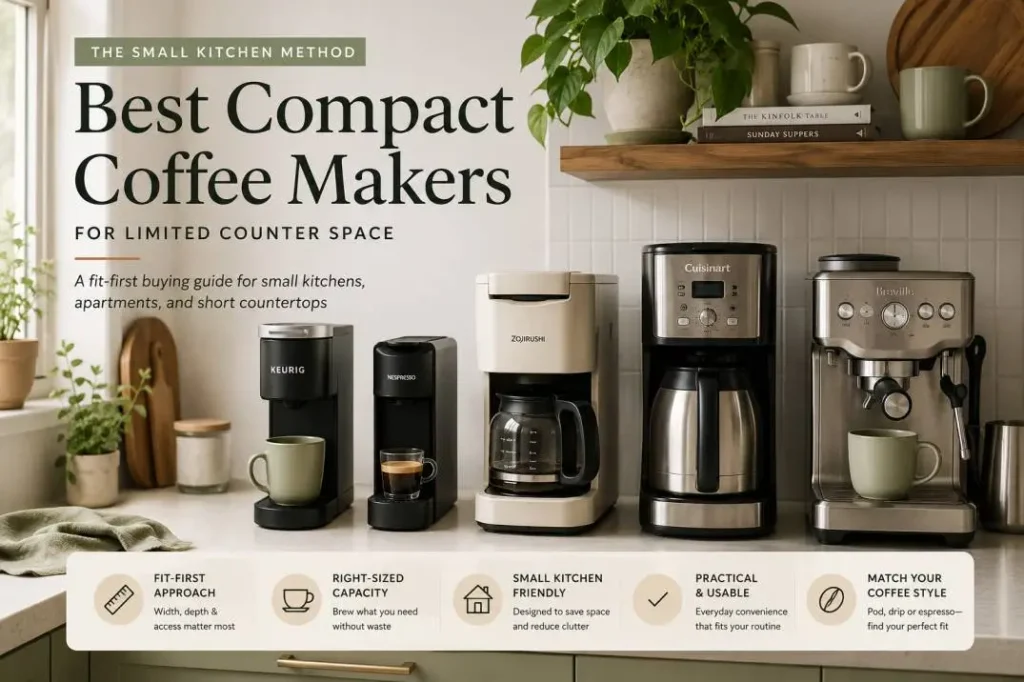
A fit-first buying guide for small kitchens, apartments, and short countertops
| Quick answer For a small kitchen, the best compact coffee makers are not automatically the smallest machine. Width matters when the counter is narrow, depth matters when the counter is shallow, and water-tank, basket, carafe, or capsule access can make a tiny footprint less practical. The strongest choices are the ones that match your coffee style while leaving a usable prep zone. |
Why compact coffee makers need a different buying test
Coffee makers are easy to underestimate because their published dimensions describe the machine body—not necessarily the space you need to fill the reservoir, lift a lid, remove a brew basket, place a mug, or access a carafe. In a small kitchen, those movements are part of the appliance’s real footprint.
That is why this guide uses a fit-first approach. Instead of treating “compact” as a marketing label, we look at width, depth, useful capacity, storage practicality, and the friction created by daily use.
The models below cover different coffee routines: pod-based single-serve brewing, small-batch drip coffee, and compact espresso. The goal is not to declare one machine perfect for everyone. It is to show which type earns its space for a particular small-kitchen setup.
Our quick picks
| Coffee maker | Published body size (W × D × H) | Useful capacity | Best for | Approx. body footprint* | Space note |
| Keurig K-Mini Plus | 4.5 × 11.3 × 12.1 in | 6–12 oz per brew | Narrowest counter width | 50.9 sq in | Very narrow; still fairly deep |
| Nespresso Essenza Mini | 3.3 × 13.0 × 8.0 in | Espresso 40 ml; Lungo 110 ml | Smallest footprint for capsule espresso | 43.0 sq in | Extremely narrow, but long front-to-back |
| Zojirushi ZUTTO EC-DAC50 | 8.875 × 5.875 × 10.625 in | 5 cups / 24 oz | Small-batch drip coffee | 52.1 sq in | Short depth; wider body |
| Cuisinart DCC-5570 | 10.14 × 5.67 × 10.85 in | 5 cups | Small drip setup with stainless carafe | 57.5 sq in | Wider than the ZUTTO |
| Breville Bambino | 6.25 × 13.5 × 12 in | 47 fl oz water tank | Compact espresso with milk steaming | 84.4 sq in | Narrow-ish but deep; needs workflow space |
*Body footprint is width × depth using published dimensions. It is a comparison aid, not the complete operating footprint. A coffee maker can need more room for filling, brewing, pouring, steam, cords, or access than its body footprint suggests.
How we judge a compact coffee maker for a small kitchen
The Small Kitchen Method evaluates products by how well they solve the reader’s physical constraint—not by how impressive the product page sounds. For this guide, the decision factors are:
- Footprint — 30%: Width × depth and how much usable counter it consumes.
- Useful capacity — 25%: How much coffee the machine realistically serves for the household, rather than only the headline capacity.
- Storage practicality — 15%: Weight, handles, cord management, removable parts, and whether it can be moved without becoming a daily chore.
- Multifunction value — 15%: Whether the machine meaningfully replaces another coffee tool or adds a useful capability.
- Daily usability — 10%: Controls, filling, cleaning, noise, and setup friction based on documented features—not hands-on claims.
- Value — 5%: Current positioning relative to fit and function; prices are intentionally not treated as fixed facts.
Because this is a researched guide rather than a hands-on test, brew flavor, long-term reliability, noise in a real kitchen, and subjective ergonomics are not scored as first-hand performance claims.
1. Keurig K-Mini Plus
Best for: Best for the narrowest coffee station
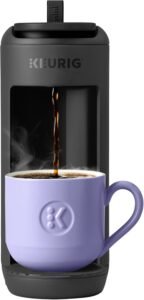
The K-Mini Plus is the most obvious fit when width is your biggest problem. Keurig lists it at 4.5 inches wide, 11.3 inches deep, and 12.1 inches high, with single-serve brewing and a removable one-cup reservoir. It can brew 6–12 oz and includes cord storage.
The trade-off is depth. A 4.5-inch-wide machine can look tiny from the front while still consuming more than 11 inches of counter depth. It also requires fresh water for each brew, so the small body does not mean a completely maintenance-free routine.
Published specs: 12.1 H × 4.5 W × 11.3 D in; 6–12 oz per brew
Skip if: Skip if you regularly brew a full carafe or want one machine to serve several people at once.
Small-kitchen reality check: Measure the counter depth as carefully as the width. Leave enough room to place the cup and perform the normal filling and brewing motions.
Check the full review: Keurig K-Mini Plus
2. Nespresso Essenza Mini
Best for: Best for an ultra-small espresso footprint
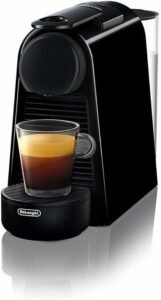
The Essenza Mini is one of the most space-efficient options in this group. Nespresso lists the rectangular model at 8.4 × 33.0 × 20.4 cm—about 3.3 × 13.0 × 8.0 inches—and a 0.6-liter removable water tank. It prepares two programmed cup sizes: a 40 ml Espresso and a 110 ml Lungo.
Its footprint is tiny, but the machine is long front-to-back. That makes it a strong option for a narrow counter that has enough depth, not necessarily for a shallow counter.
Published specs: Approx. 3.3 W × 13.0 D × 8.0 H in; 0.6 L tank; Espresso/Lungo
Skip if: Skip if you want a traditional pot of drip coffee or need large mugs and larger batch capacity.
Small-kitchen reality check: Check the full 13-inch depth before buying. The narrow width is impressive, but it does not eliminate the need for front-to-back counter space.
Official product information: Nespresso Essenza Mini product page
3. Zojirushi ZUTTO EC-DAC50
Best for: Best for small-batch drip coffee
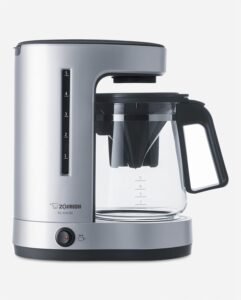
The ZUTTO EC-DAC50 takes a different approach to small-space brewing: instead of being extremely narrow, it keeps the body relatively shallow. Zojirushi lists dimensions of 8-7/8 × 5-7/8 × 10-5/8 inches and a capacity of up to 5 cups or 24 oz.
That makes it particularly interesting for a counter where front-to-back depth is the main constraint. It also has a removable water tank, automatic keep-warm function, and a charcoal water filter designed to last up to two years under normal use.
Published specs: 8-7/8 W × 5-7/8 D × 10-5/8 H in; 5 cups / 24 oz
Skip if: Skip if your counter is extremely narrow from side to side or if you only ever make one cup at a time.
Small-kitchen reality check: The ZUTTO is a good reminder that “compact” should be measured in two directions. Its width is larger than the K-Mini Plus, but its shallow depth can be easier to live with on a tight counter.
Official product information: Zojirushi ZUTTO EC-DAC50 product page
4.Cuisinart DCC-1200P1 Brew Central
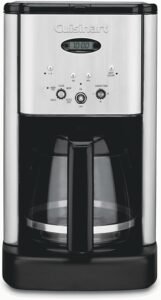
The Cuisinart DCC-1200P1 Brew Central takes a different approach to small-kitchen coffee: it offers a full 12-cup drip setup while keeping its published body depth to 7.75 inches. Cuisinart lists it at 9 inches wide, 7.75 inches deep, and 14 inches high, with a 12-cup glass carafe, 24-hour programming, adjustable keep-warm temperature control, Brew Pause, programmable auto shutoff, and a charcoal water filter.
The key advantage here is its relatively shallow front-to-back footprint for a full-size 12-cup drip coffee maker. That can make it worth considering when counter depth is more restrictive than width. The main compromise is overall size: at 14 inches high with a 12-cup carafe, it is a substantially larger coffee setup than the single-serve and 5-cup models in this guide. Its height also makes cabinet clearance and access an important part of the fit check.
Published specs: 9 W × 7.75 D × 14 H in; 12-cup glass carafe; 24-hour programmability
Skip if: Skip if you have very limited vertical clearance, mainly brew one cup at a time, or want the smallest possible coffee maker for a very narrow counter.
Small-kitchen reality check: The 7.75-inch depth is useful when front-to-back counter space is your main constraint, but do not judge the fit by depth alone. Measure the 14-inch height and check the space needed to access the water reservoir, filter basket, controls, and carafe in the exact location where you plan to use it. The published body dimensions are the starting point—not the complete operating footprint.
5. Breville Bambino
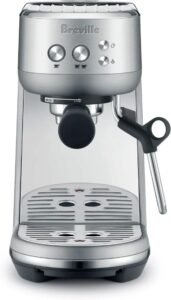
Best for: Best for compact espresso with manual milk steaming
The Bambino is the outlier in this list because it targets espresso rather than simple drip or pod brewing. Breville lists the machine at 6.25 inches wide, 13.5 inches deep, and 12 inches high, with a 47 fl oz water tank, 1- and 2-cup controls, hot water, and a manual steam wand.
Its narrow width can work surprisingly well on a tight counter, but the 13.5-inch depth and the extra workflow around a portafilter, milk jug, tamper, and steam wand mean its real space cost is much larger than the body alone.
Published specs: 6.25 W × 13.5 D × 12 H in; 47 fl oz tank
Skip if: Skip if you want the smallest possible coffee setup or do not want espresso prep and cleanup.
Small-kitchen reality check: Think of the Bambino as a compact espresso workstation, not simply a small coffee maker. Measure the full working area, not only the machine body.
Official product information: Breville Bambino product page
Which compact coffee maker fits your counter?
Use your counter shape—not the product’s marketing label—to narrow the field.
| If your constraint is… | Start with… | Why | Watch out for… |
| Very narrow counter width | Keurig K-Mini Plus or Nespresso Essenza Mini | Both use unusually little width. | Both are relatively deep. |
| Shallow counter depth | Zojirushi ZUTTO or Cuisinart DCC-5570 | Both have body depths under 6 inches. | The ZUTTO/Cuisinart are wider. |
| Two people want drip coffee | Zojirushi ZUTTO or Cuisinart DCC-5570 | Small-batch carafes make more sense than one-cup brewing. | 5-cup labeling is not the same as five large mugs. |
| Espresso is the priority | Nespresso Essenza Mini or Breville Bambino | Choose between capsule simplicity and manual espresso workflow. | The Bambino needs much more working space. |
| You want the least counter width | Nespresso Essenza Mini | Its published width is about 3.3 inches. | Its 13-inch depth changes the equation. |
How to measure your counter before buying
Do this before clicking an affiliate link. A coffee maker that technically fits the counter can still be a poor fit if you cannot fill it, brew into your preferred mug, remove the carafe, or clean the removable parts.
- Measure usable width: Measure the clear side-to-side space where the machine body will sit. If another appliance stays beside it, measure the remaining gap—not the whole counter.
- Measure usable depth: Measure from the back edge to the front edge. Then account for the space you need to stand a mug, open a reservoir, or pull out a carafe.
- Check height: Look for cabinets or shelves above the coffee maker. The machine may fit vertically but still be difficult to fill or maintain.
- Map the access path: Identify where the water tank, brew basket, capsule container, or carafe comes out. The access path is part of the footprint.
- Plan the cord and outlet: Make sure the cord can reach the intended outlet without forcing the machine into an awkward position. Follow the exact product manual for electrical use.
- Measure storage if it will not stay out: If you plan to store the machine after brewing, measure the cabinet opening and shelf—not just the interior volume.
A simple counter-space test
Take a sheet of paper or painter’s tape and mark the machine’s published width × depth on your counter. Then simulate the normal access movement with your hands. Can you still open the reservoir? Can you place the mug where it belongs? Can you remove the carafe or brew basket without hitting another appliance?
If the answer is no, the machine does not really fit—even if its published dimensions fit inside the rectangle.
See our ful review on : How to Store Small Appliances in a Small Kitchen
Worked example: a 24-inch counter run
Imagine a renter has a 24-inch-wide section of counter and wants to keep a coffee maker beside a compact air fryer. The goal is not to fill the entire counter; it is to preserve a usable prep zone.
| Item | Published width | Space remaining from 24 in |
| Keurig K-Mini Plus | 4.5 in | 19.5 in before other items |
| Zojirushi ZUTTO | 8.875 in | 15.125 in before other items |
| Cuisinart DCC-5570 | 10.14 in | 13.86 in before other items |
The calculation is intentionally simple. It does not mean the entire remaining width is usable prep space, because you still need room for the neighboring appliance, cords, mugs, and normal movement. The point is to compare the counter-space cost before purchase.
Should your coffee maker stay on the counter?
Usually, the answer depends on frequency. A coffee maker used every morning is a stronger candidate for permanent counter space than a machine used only for weekend guests.
- Keep it out when: you use it most days, the counter location allows safe operation, and leaving it out does not block your main prep zone.
- Store it when: you use it occasionally, it is easy enough to retrieve, or its footprint prevents you from completing everyday cooking tasks.
- Relocate it when: the current position forces you to reach around another appliance, blocks a cabinet door, or creates a poor workflow.
See our full review on :What Should Stay on a Small Kitchen Counter? A Guide
Choose the coffee style before choosing the machine
| Your routine | Best format | Why it can work in a small kitchen | Main trade-off |
| One cup at a time | Single-serve pod | Small width and little leftover coffee. | Pods add storage and ongoing consumable costs. |
| Two people want a pot | 5-cup drip | More coffee without the footprint of a full-size brewer. | Usually wider than the narrowest single-serve models. |
| Espresso and milk drinks | Compact espresso | One machine can handle espresso, hot water and milk texturing. | More tools, cleanup, and operating space. |
| Rare coffee use | Small manual setup or stored compact machine | Keeps permanent counter space available. | More setup each time. |
Maintenance and storage matter too
A coffee maker is easier to live with when its cleaning routine matches your kitchen. Look for removable reservoirs, removable brew baskets, accessible filters, and parts that can be cleaned without moving half the counter.
Follow the exact manufacturer’s instructions for cleaning, descaling, water handling, and storage. For example, Mr. Coffee’s current 5-cup Mini Brew instructions state that the coffeemaker should be unplugged and cooled completely before cleaning, and the manufacturer recommends regular mineral-deposit removal.
If you store the machine between uses, let it cool as directed, empty or dry components when the manual calls for it, manage the cord without damaging it, and keep the appliance in a clean, dry location.
Common small-kitchen coffee-maker mistakes
- Buying by width alone. A narrow machine can still be too deep for your counter.
- Treating body dimensions as the full operating footprint. Reservoir lids, baskets, carafes, mugs, and steam wands need movement space.
- Buying a large batch brewer for a one- or two-person household simply because it is on sale.
- Leaving coffee accessories scattered around the machine. The coffee maker may be compact while the surrounding coffee station is not.
- Putting the machine in a location that blocks a cabinet, drawer, or your main prep run.
- Assuming a machine is easy to store without measuring the cabinet opening and shelf height first.
Try this no-buy test first
Before replacing your current coffee maker, mark its width and depth on the counter with removable tape. For seven days, notice three things: how often you use it, whether it interrupts food prep, and whether you can access every control and removable part without moving another object.
If the machine is rarely used and consistently costs you prep space, the problem may be placement rather than the machine itself. If you use it daily but its footprint is excessive, that is when a narrower or shallower replacement can make a meaningful difference.
FAQs
What is the smallest coffee maker for a small counter?
Among the models in this guide, the Nespresso Essenza Mini has the smallest published width at about 3.3 inches, while the Keurig K-Mini Plus is 4.5 inches wide. The Essenza Mini is also about 13 inches deep, so the smallest width does not automatically mean the smallest overall fit.
Is a 5-cup coffee maker enough for two people?
It can be, depending on cup size. Zojirushi lists the ZUTTO at up to 5 cups or 24 oz, while Mr. Coffee describes its 5-cup Mini Brew as up to 25 oz and suitable for two 12-oz cups. Check the manufacturer’s cup definition rather than assuming a “cup” equals a large mug.
Should a compact coffee maker stay on the counter?
If you use it most days and the location does not interfere with prep or cabinet access, permanent counter storage can make sense. If you use it occasionally, storing it may save more space than buying an even smaller machine.
How much counter depth does a coffee maker need?
Use the machine’s published depth as the starting point, then add the space required for filling, pouring, opening, or removing parts. There is no single universal operating-depth number for every coffee maker.
Which is better for a small kitchen: pod or drip?
It depends on your routine. Pod machines can minimize width and simplify one-cup brewing, while small drip machines make more sense when two people regularly want several cups. Choose the format first, then compare footprints within that category.
Can I put a coffee maker under a cabinet?
Do not assume that a compact machine can operate safely under any cabinet. Check the exact manufacturer’s instructions for the model, especially around heat, steam, ventilation, and access.
Bottom line
The best compact coffee maker for a small kitchen is the one that matches your coffee routine without consuming more counter space than the job is worth. If width is your biggest constraint, start with the Keurig K-Mini Plus or Nespresso Essenza Mini. If shallow depth matters more, the Zojirushi ZUTTO and Cuisinart 5-Cup deserve a closer look. If espresso is the priority, the Breville Bambino offers a compact body but needs a much larger working footprint.
Before buying, measure the real counter location, simulate access to the machine, and decide whether the appliance will earn permanent counter space. That is the Small Kitchen Method: fit first, then features.