
What Should Stay on a Small Kitchen Counter? A Practical Space Audit
Keep only the items that support your real daily routine without blocking prep, cleaning, storage access, or safe appliance operation.
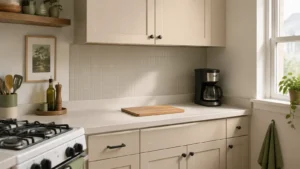
A small kitchen counter can become crowded with one reasonable item at a time: the coffee maker you use every morning, the toaster you use twice a week, the utensil crock, the dish rack, the fruit bowl, and the appliance you are still deciding where to store.
Generic rules such as “keep out everything you use daily” or “hide every appliance” miss the real constraint. Two people may own the same toaster, but one has a 72-inch counter run and the other has only 28 inches of uninterrupted prep space.
The useful question is not whether an item looks good on the counter. It is whether that item earns permanent counter space after you account for frequency, footprint, workflow, cleaning, access, and safety.
QUICK ANSWER A small kitchen counter should usually hold only items used often enough to justify immediate access and that can stay without blocking your main prep area, sink, stove, drawers, cabinet doors, outlets, or safe appliance clearance. Keep a daily-use appliance only when it has no practical nearby home and its exact manual permits the location. Move weekly items to easy-access storage, store occasional items farther away, and remove duplicates or objects with no current job.
The keep, move, store, or remove matrix
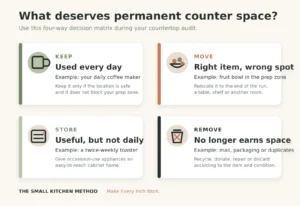
| Decision | Use this rule | Typical examples—not universal |
| KEEP | Supports a near-daily routine, has no practical alternate home, and is safe and easy to clean around | Coffee maker used every morning; soap dispenser; one compact utensil holder used at most meals |
| MOVE | Useful, but it blocks prep or belongs closer to another zone | The dish rack shifted over the sink; fruit bowl moved away from the main cutting area |
| STORE | Used weekly or less; can be retrieved without excessive lifting or setup friction | Blender, toaster, stand mixer, rice cooker, or food processor that is not part of the daily routine |
| REMOVE | Duplicate, broken, expired, recalled, unused, or present only because it lacks a decision | Extra utensil crock; damaged appliance; old mail; empty packaging; duplicate knife block |
Limitation: these examples are prompts, not a universal countertop list. A coffee maker used twice a month may belong in storage; a blender used twice a day may earn a permanent place.
What actually decides whether an item earns counter space
1. Frequency matters—but friction changes the answer
Daily use is a strong reason to keep something accessible, but it is not automatic permission to occupy the counter. Also ask what retrieving it requires. A lightweight toaster in a waist-high cabinet is easy to store; a heavy mixer in a deep lower cabinet may be unrealistic to lift repeatedly. The goal is to reduce total friction without sacrificing your only work surface.
2. Measure the uninterrupted prep run
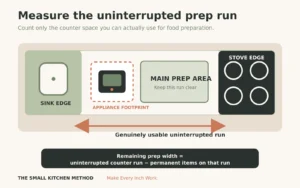
Do not count every inch of countertop in the room as if it were one usable surface. Measure the single uninterrupted section where you actually chop, mix, plate, or pack food. Stop at the sink, stove, wall, tall appliance, or any object that breaks the work area.
Editorial calculation: remaining prep width = usable uninterrupted counter run − width occupied by items on that same run. This is a planning measure, not a building standard. Depth, handles, cords, door swing, and operating clearance may reduce practical space further.
3. Stored footprint is not operating space
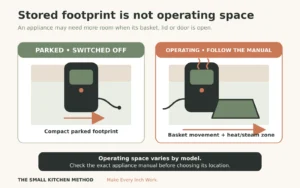
A small appliance may fit neatly against the backsplash while turned off but need to move forward, open a lid or basket, vent heat or steam, and reach an outlet during use. That larger operating envelope—not the parked position—determines whether the setup works. Follow the manual for the exact model; do not borrow a clearance number from another appliance. Read our article “How Much Clearance an Air Fryer Needs.”
4. Every permanent item affects cleaning
FoodSafety.gov advises washing countertops, cutting boards, dishes, and utensils with hot, soapy water, especially after contact with raw meat, poultry, seafood, or eggs. A practical inference for organization is that permanent counter items should be easy to move and easy to clean around; an arrangement that traps crumbs or prevents the surface from being washed is not earning its space.
5. The item must fit a zone, not just an empty corner
A useful counter supports a sequence: take out ingredients, prepare, cook, plate, and clean. An item can fit physically and still interrupt that sequence. Keep coffee supplies near the coffee maker, washing tools near the sink, and active cooking tools where they are reachable without crowding the stovetop. Redirect mail, keys, medicine, and charging cables to a non-food landing zone when possible.
How to audit your small kitchen counter
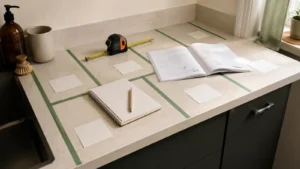
You need a tape measure, painter’s tape or removable notes, your appliance manuals, and seven ordinary days. Do not buy storage products before completing the audit.
- Clear one section at a time. Move everything from one uninterrupted counter run to a table. Clean the surface, then return only items needed for the next normal meal or routine.
- Measure the working run. Record the width and depth of the space you truly use for prep. Note cabinet doors, drawers, the sink edge, the stove, outlets, low upper cabinets, and anything that limits movement.
- Measure each candidate item. Record width and depth in its parked position. For appliances, also note the cord path, lid or basket movement, steam direction, and the exact model’s documented clearance requirements.
- Assign a zone and frequency. Label each item daily, several times a week, weekly, monthly, or seasonally. Then assign it to prep, cooking, coffee, washing, food storage, or a non-kitchen landing zone.
- Run the Counter Permission Test. Score the five questions below. If the location fails a safety or manual requirement, the item does not stay there regardless of score.
- Test the setup for seven days. Mark every time you move an item just to make space, cannot open a drawer, clean around a base, or pull an appliance forward. Those are signs the parked layout is costing more space than the measurement suggests.
- Commit to a home. Keep the winners, move weekly items to easy-access storage, place monthly items farther away, and remove duplicates, damaged items, expired goods, and packaging.
The Counter Permission Test
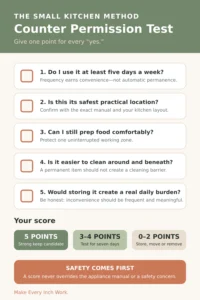
Give one point for each “yes.” This is an original editorial decision aid, not a safety standard.
| Point | Question |
| 1 | Do we use it at least four days in a normal week? |
| 2 | Does immediate access noticeably reduce repeated lifting, setup, or cleanup? |
| 3 | Can it stay without shrinking or splitting the main prep run? |
| 4 | Can we still open drawers and doors, reach outlets, and clean the surface easily? |
| 5 | Is this exact location permitted by the product manual and clear of heat, steam, water, traffic, and cord problems? |
- 5 points: strong candidate to keep out.
- 3–4 points: test for seven days or move it to a better zone.
- 0–2 points: store, relocate, replace with an item you already own, or remove.
SAFETY OVERRIDE A score never overrides the exact appliance manual, a recall notice, damaged wiring, landlord rules, or professional electrical guidance.
Worked example: a 48-inch counter run
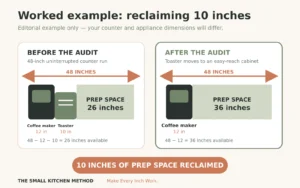
Assumptions: a renter has one uninterrupted 48-inch-wide counter section used for prep. A 12-inch coffee maker and a 10-inch toaster sit on that same run. The appliance widths are example measurements supplied for the scenario, not product specifications.
| Line item | Width | Decision path |
| Starting prep run | 48 in | Measured uninterrupted width |
| Coffee maker | −12 in | Used daily; scores 5/5; remains |
| Toaster | −10 in | Used twice weekly; scores 2/5; moves to cabinet |
| Prep width before audit | 26 in | 48 − 12 − 10 |
| Prep width after audit | 36 in | 48 − 12 |
| Width reclaimed | 10 in | Editorial calculation based on measured widths |
The coffee maker stays because it supports a daily routine and passes the access and safety checks. The toaster is not discarded; it moves to the easiest cabinet shelf and is tested there for one week. If retrieving it proves unreasonable, the renter can reconsider the zone—not automatically buy another appliance or organizer.
What to do in common small-kitchen situations
If you have only one short prep zone
Protect that uninterrupted run first. Move décor, paperwork, bulk food, and weekly appliances elsewhere before relocating daily washing essentials. If an appliance must stay, park it at the end of the run rather than in the middle, provided the manual, outlet, cord, heat, and steam path allow that location.
If you rent
Start with reversible changes: use an existing cabinet shelf, a removable bin, an over-the-sink drying setup you already own, or a rolling cart if there is a safe traffic-free location. Confirm the lease or landlord’s rules before drilling, changing outlets, mounting rails, or attaching heavy storage to walls or cabinets.
If one person uses the kitchen
Keep the setup narrow and personal. A single mug, one cutting board, or one compact appliance may serve the full routine. Avoid using countertop containers to store backups you rarely reach for.
If two or three people share the kitchen
The winning item should support the shared routine, not only one person’s occasional preference. Leave enough space for handoffs and simultaneous access. A larger daily appliance may earn its footprint if it replaces two separate tools; a collection of individual gadgets usually needs stronger justification.
If an item is used daily but blocks a drawer or outlet
Daily use does not cancel access problems. Try the opposite end of the counter, a nearby open shelf rated for the item’s weight, or an easy-access cabinet. For heat-producing appliances, confirm the full operating setup using the exact manual before choosing a new parked location.
If you are deciding between two appliances
Compare what each replaces, not only its body dimensions. If both would duplicate the same job, choose the one that fits the household’s real meals and storage. For a focused comparison, see the planned guide to an air fryer vs. toaster oven for a small apartment. If you already know an air fryer fits your routine, compare the small-kitchen trade-offs in the site’s best slim air fryers for small kitchens guide.
Small-kitchen counter mistakes—and practical fixes
| Mistake | Why it fails | Fix |
| Keeping every daily-use item out | Daily use becomes the only rule, so the prep zone disappears | Apply all five permission questions; protect the main uninterrupted work run |
| Buying an organizer before auditing | The organizer contains clutter without changing what belongs | Complete the seven-day test first; buy only for a verified access problem |
| Measuring only appliance width | Depth, handles, cords, lid lift, basket pullout, heat, and steam are ignored | Record both parked footprint and manual-based operating envelope |
| Creating a paper landing zone beside food prep | Mail, keys, and charging cables spread into cooking space | Move them to an entryway, wall pocket, drawer, or lidded non-food zone |
| Leaving damaged or recalled products in place | Familiarity delays a necessary stop-use decision | Stop using damaged products and check the CPSC recall database by brand and model |
| Making the counter hard to wash | Bases and clusters trap crumbs and splashes | Reduce the number of permanent items and choose homes that allow easy movement and cleaning |
Safety and limitations
This article can help you decide where an item fits in your routine. It cannot determine whether a particular outlet, circuit, shelf, cart, wall mounting point, or appliance location is safe for your home.
- Follow the manual for the exact appliance model, including surface, cord, ventilation, heat, steam, lid, door, and basket instructions.
- The U.S. Fire Administration advises keeping anything that can catch fire away from the stovetop, unplugging small appliances when they are not in use, avoiding overloaded outlets, and replacing an appliance with a cracked, damaged, or loose cord.
- Check the U.S. Consumer Product Safety Commission recall database if an appliance is older, secondhand, behaving unusually, or included in a safety notice.
- Stop using an item and seek qualified help if you notice smoke, sparking, melting, burning odors, shocks, repeated breaker trips, a damaged cord or plug, unusual overheating, or another condition the manual identifies as unsafe.
Ask a qualified electrician about outlets, repeated breaker trips, damaged wiring, or circuit capacity. Ask the landlord before permanent alterations. For structural mounting, plumbing, gas, mold, or building-code questions, use the appropriate qualified professional.
The no-buy version
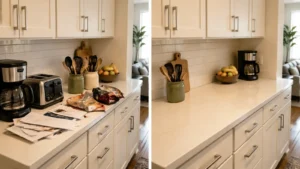
You can complete this reset with a tape measure, removable notes, and the storage you already have. Use a sturdy bowl as a temporary small-item corral, place a weekly appliance on the easiest existing shelf, and use a sheet pan or tray you already own to test whether grouping a coffee setup helps. If the trial does not improve prep or cleanup after seven days, remove the container rather than buying a prettier one.
A no-buy reset stops being adequate when an item has no safe home, repeated lifting is unrealistic, a cabinet cannot support the weight, or the proposed location conflicts with the manual. At that point, define the exact problem—weight, reach, clearance, or capacity—before selecting a storage product or replacement appliance.
Recheck routine
Repeat the counter audit after a move, a new appliance, a change in household size, a new cooking routine, or any week when you repeatedly shuffle items to prepare food. Recheck appliance manuals after a model replacement, and check recall information when a product receives a safety notice or begins behaving unusually.
For a light weekly reset, return mail and non-kitchen objects to their homes, wipe under permanent items, and move anything that has not been used in the last seven days to a review shelf. Monthly, decide whether those review-shelf items deserve easy-access storage or should leave the kitchen.
Printable seven-day countertop audit
| Item | W × D | Uses / week | Zone | Moved to prep? | Score /5 | Decision |
| ________________ | ________ | ________ | ________ | Y / N | ____ | Keep / Move / Store / Remove |
| ________________ | ________ | ________ | ________ | Y / N | ____ | Keep / Move / Store / Remove |
| ________________ | ________ | ________ | ________ | Y / N | ____ | Keep / Move / Store / Remove |
| ________________ | ________ | ________ | ________ | Y / N | ____ | Keep / Move / Store / Remove |
| ________________ | ________ | ________ | ________ | Y / N | ____ | Keep / Move / Store / Remove |
Daily note: Record every time you move an item to create a workspace, unplug it, clean around it, or open a blocked drawer. At the end of day seven, make one decision for each item.
Frequently asked questions
How much of a small kitchen counter should be left clear?
There is no universal percentage that works for every kitchen. Protect one uninterrupted prep run large enough for your normal cutting board, mixing bowl, or meal setup. Measure that run and watch whether permanent items force you to prepare food over the sink, stove, or another unsuitable surface. Use your routine and real dimensions, not an arbitrary minimalist target.
Should a toaster stay on the counter?
Only if its frequency and access needs justify the footprint. A daily toaster with no practical storage home may earn a place; one used on weekends may be better on an easy cabinet shelf. Follow the exact manual for placement and operation, keep the cord and outlet safe, and unplug the appliance when not in use in line with U.S. Fire Administration guidance.
Which appliances deserve permanent counter space?
Usually the ones used most often are difficult to lift repeatedly and genuinely useful to the household—provided they do not block prep, cleaning, drawers, doors, outlets, or manual-required operating space. A coffee maker, air fryer, blender, or mixer can qualify in one home and fail in another. The Counter Permission Test makes that difference visible.
Is it okay to keep an air fryer under upper cabinets?
Do not assume so. The correct answer depends on the exact model’s manual, the counter depth, overhead materials, vent and steam direction, cord path, and basket movement. A parked air fryer may need to move for operation. Start with the site’s guide to how much clearance an air fryer needs, then confirm the instructions for your model.
What should never be stored beside the stove?
Keep anything that can catch fire away from the stovetop. That can include paper, packaging, towels, and other combustible items. Also avoid placing an appliance where heat, steam, splatter, or pan movement conflicts with its manual. The safest distance and setup may be model- and kitchen-specific, so do not substitute a generic organizing rule for the instructions.
How do I organize a counter when I have almost no cabinet storage?
Prioritize zones and vertical options before buying containers. Move non-kitchen objects out, keep backups elsewhere, use the sink area for washing rather than prep, and test a cart or removable shelf only if it does not narrow traffic or create a lifting problem. If an appliance must remain out, place it at the edge of the prep run after confirming safe operation.
Do trays make a small counter less cluttered?
A tray can make a true zone easier to move and clean, but it can also preserve items that should not be there. Test one you already own for seven days. Keep it only if the whole group is used together, the tray is easy to lift and wash, and it does not enlarge the footprint or become a landing place for unrelated objects.
Bottom line
What should stay on a small kitchen counter is not a fixed list. Keep the few items that support the real daily routine, pass the safety and access checks, and leave one useful uninterrupted prep area. Move weekly items to easy storage, store occasional items farther away, and remove duplicates, damaged products, and objects with no current job.
Start with one counter run and the seven-day audit. If the result shows that an air fryer genuinely fits the routine, compare the best slim air fryers for small kitchens; before choosing a location, check how much clearance an air fryer needs; and for a model-specific decision, read the Bella 4-Quart Slim Air Fryer review.
Sources and verification
| Source | Organization | Direct URL | Supports | Date |
| 4 Steps to Food Safety | FoodSafety.gov | Open official page | Supports washing countertops, cutting boards, dishes, and utensils with hot, soapy water; also supports separating raw-food tools. | Verified Aug. 5, 2026 |
| Appliance and Electrical Fire Safety | U.S. Fire Administration (FEMA) | Open official page | Supports unplugging small appliances when not in use, avoiding overloaded outlets, and replacing appliances with cracked, damaged, or loose cords. | Verified Aug. 5, 2026 |
| Cooking Fire Safety | U.S. Fire Administration (FEMA) | Open official page | Supports keeping anything that can catch fire away from the stovetop and watching active cooking. | Verified Aug. 5, 2026 |
| Recalls & Product Safety Warnings | U.S. Consumer Product Safety Commission | Open official page | Supports checking current product recalls and following the remedy stated in a recall notice. | Verified Aug. 5, 2026 |
Pingback: 10 Dollar Tree Fall Kitchen Decor Ideas That Actually Work in Small Kitchens