
How to Store Small Appliances in a Small Kitchen (So You Will Actually Use Them)
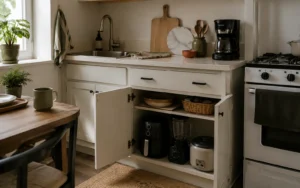
Clear the counter without creating a cabinet full of appliances that are too heavy, too hidden, or too awkward to retrieve.
Small-appliance storage is not only a question of finding an empty shelf. In a compact kitchen, the wrong home can turn a useful blender, air fryer, rice cooker, or waffle maker into something you avoid because getting it out takes too much effort.
The goal is not to hide every appliance. It is to give each one the easiest safe home its use frequency deserves, while protecting the prep space you need every day. That means measuring the appliance, the cabinet opening, and the path between storage and operation—then testing the routine in real life.
By the end of this guide, you will know what should stay out, what belongs in an easy-access cabinet, what can move to deeper storage, and what may no longer earn space in your kitchen.
| QUICK ANSWER Store daily-use appliances either on the counter or in the nearest one-move cabinet location. Put weekly appliances on an easy shelf that does not require moving other items first. Reserve deeper or higher storage for light, occasional items. Measure the cabinet opening as well as its interior, keep heavy appliances within a comfortable lifting zone, and store electrical appliances unplugged, cool, clean, dry, and with cords loosely arranged. Always follow the exact appliance manual. |
Start with four storage zones
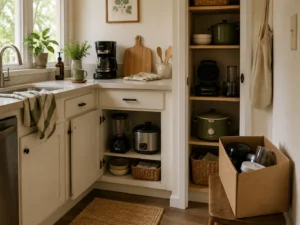
Use this as a flexible starting point, not a rule about how often everyone should cook. The best zone is the one that makes your real routine easier without sacrificing prep space or safety.
| Use a pattern. | Best starting zone | Small-kitchen test |
| Daily or nearly daily | Counter or nearest easy-access cabinet | Does it protect enough uninterrupted prep space, and can it be operated exactly as the manual requires? |
| Several times a week | Front of a waist-level or easy lower cabinet | Can you retrieve it in one move without lifting another appliance first? |
| Monthly or seasonal | Deeper cabinet, pantry, or nearby dry storage | Is it light enough for that height, and will you remember where its parts are? |
| Rarely used or duplicated | Temporary holding zone outside prime kitchen storage | Would another tool do the same job? If you do not use it during the test period, can it leave? |
Limitation note: frequency alone does not decide placement. Weight, reach, cabinet structure, moisture, cord condition, and the exact manual can override the preferred zone.
The variables that actually decide where an appliance belongs
1. Use frequency, not purchase price
A costly appliance does not automatically deserve counter space, and an inexpensive appliance is not automatically clutter. Start with what you use. A coffee maker used every morning may earn a permanent station. A large mixer used four times a year may need a dry, lower-priority home outside the main cooking zone.
2. Retrieval friction
Count the actions required to use the appliance. Opening one door and lifting one item is low friction. Moving a stack of pans, untangling a cord, finding a missing lid, and carrying the appliance across the home is high friction. If storage makes a useful appliance hard to start using, the location is not working.
3. Stored fit versus operating space
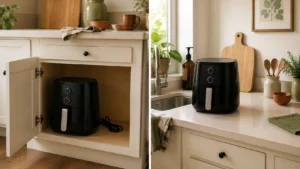
The appliance may fit on a shelf while switched off but still need a different setup for use. Lids lift, baskets pull forward, steam rises, vents need space, and cords must reach a suitable receptacle. Treat the cabinet as storage only unless the exact manual and a properly designed installation say the appliance can operate there. For heat-producing appliances, move the unit to its documented operating position before plugging it in.
4. Weight and reach
A high shelf can hold an occasional lightweight hand mixer more realistically than a heavy stand mixer. Workplace ergonomic guidance recommends minimizing reach and storing heavy objects around waist level; applied to a home kitchen, the practical lesson is to keep heavier or frequently lifted appliances in a stable, easy-to-reach zone rather than overhead. Your strength, mobility, shelf construction, and appliance shape still matter. [4]
5. The complete appliance kit
The base is only part of the footprint. Record the bowl, basket, lid, blade, tamper, rack, measuring cup, power cord, and any removable water tank. If accessories live in several places, the appliance can feel inconvenient even when the base is easy to reach.
How to store small appliances in a small kitchen: a seven-step method
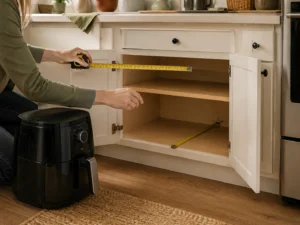
You need a tape measure, removable notes or paper labels, the appliance manuals, and about 30 minutes. Use the manufacturer’s published weight if it is available; otherwise do not guess a number just to complete the worksheet.
- List every appliance and its last real use. Include what is on the counter, inside cabinets, in a pantry, and stored elsewhere. Mark daily, weekly, monthly/seasonal, or not used in the last six months. A seasonal appliance is not the same as an unwanted appliance, but it does not need prime storage all year.
- Measure the stored shape. Record maximum width, depth, and height with all parts in their storage position. Include handles, feet, protruding controls, cord storage, and any accessory container. If a lid or basket must be removed to store the unit, record both pieces.
- Measure the opening and the interior. The narrowest door opening may be smaller than the cabinet interior because of a face frame, hinge, shelf lip, or door. Record usable width, depth, and height, then check the turn or tilt needed to insert and remove the appliance.
- Check the storage fit margin. For each direction, subtract the appliance’s maximum stored dimension from the usable opening or interior dimension. A positive number is only a first pass. You still need room for your hands, the cord, protrusions, and a smooth retrieval path. Do not invent a universal buffer.
- Assign the easiest zone the appliance earns. Daily items receive the lowest-friction home. Heavy items stay within a comfortable, stable lifting range. Occasional light items can move deeper or higher. Keep electrical appliances out of damp or leak-prone locations and follow the manual’s storage instructions.
- Create a one-move setup. Store each appliance so it can come out without lifting or relocating another appliance. Keep the parts together in an existing bowl, tray, or labeled bag if that reduces searching. Arrange the cord loosely without sharp bends or tension where it enters the appliance.
- Run a seven-day reality test. Cook normally. Each time you use an appliance, notice whether retrieval, setup, cleaning, drying, and return feel reasonable. If the appliance never returns to its home or blocks another task, change the location before buying an organizer.
| FIT FORMULA Storage fit margin = usable cabinet dimension – maximum stored appliance dimension. Calculate width, depth, and height separately. Then verify the cabinet opening, hand clearance, cord position, shelf strength, and retrieval path. A positive margin does not guarantee a workable or safe setup. |
Worked example: choosing a home for an air fryer
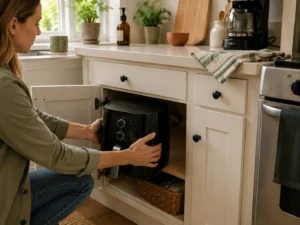
This is an editorial example using rounded hypothetical measurements. It does not describe a specific model or guarantee fit in another cabinet.
| Check | Cabinet or appliance | Editorial calculation |
| Usable cabinet opening | 21.75 in W x 20.5 in D x 17.5 in H | Measure the narrowest opening, not only the interior box. |
| Stored appliance | 11.75 in W x 14.5 in D x 12.5 in H | Measure the appliance in its actual stored configuration. |
| Width margin | 21.75 – 11.75 | 10.0 in remaining |
| Depth margin | 20.5 – 14.5 | 6.0 in remaining |
| Height margin | 17.5 – 12.5 | 5.0 in remaining |
On paper, the appliance fits. The final decision is whether it passes through the opening without a difficult tilt, whether both hands can grip it, whether the shelf is stable, and whether it can move straight to a counter location that meets the exact manual’s operating instructions. The cabinet is a storage home, not an automatic operating station.
Decision branches for real small kitchens
If you have no spare cabinet
Protect one uninterrupted prep area first. Keep only the appliances you use most on the counter, grouped at one end rather than scattered across the work surface. Move occasional appliances to a nearby dry closet, dining-room cabinet, or stable cart if the route is short and retrieval is realistic. If you need help deciding what earns counter space, use the site’s practical small-counter audit.
If you rent
Prioritize reversible changes: shelf rearrangement, existing bins, freestanding storage, and removable labels. Do not add outlets, alter cabinet wiring, mount a heavy shelf, or create a concealed appliance station without permission and qualified help. A renter-safe setup should leave the kitchen easy to restore.
If the appliance is heavy
Give it a stable shelf in your easiest lifting range. Do not store it above shoulder height simply because the upper cabinet is empty. If the only available home requires a lift you avoid, the appliance may need to stay on the counter, move to sturdier nearby furniture, or be replaced only when replacement already makes sense.
If the appliance is used daily
The counter may be the correct home if the appliance leaves enough prep space and can be placed safely. A clear counter is not a success if every breakfast begins with hauling a coffee maker out of a deep cabinet. The right small kitchen is practical, not performatively empty.
If the accessories keep disappearing
Treat the appliance and its parts as one kit. Store small blades or paddles in a labeled container next to the base or inside the appliance only when its manual permits that arrangement and the parts cannot damage one another. Keep sharp components protected and inaccessible to children.
Common appliance-storage mistakes and practical fixes
| Mistake | Why it fails | Practical correction |
| Buying a rack before auditing | The organizer may consume the space the appliance needs. | Assign homes first; buy only if a measured access problem remains. |
| Measuring the cabinet interior only | The door frame, hinge, or shelf lip can block insertion. | Measure the narrowest opening and the turn required to remove the appliance. |
| Stacking appliances | The lower item becomes a two-move task, and surfaces may not be designed for loads. | Use one appliance per retrieval path unless the manufacturer and shelf design support the arrangement. |
| Storing before cool and dry | Heat, moisture, residue, and odor are trapped in storage. | Unplug, cool, clean, and dry the appliance according to its manual before putting it away. |
| Wrapping the cord tightly | Sharp bends or tension can damage the cord over time. | Use built-in cord storage or a loose loop with no stress at the appliance entry point. |
| Putting a heavy appliance overhead | Repeated high lifting increases effort and makes use less likely. | Move it to a stable waist-level or comfortable lower shelf. |
| Operating inside a closed cabinet | Stored fit does not provide operating clearance, ventilation, steam, or access. | Move the appliance to its model-specific operating position before plugging it in. |
| Using under-sink space by default | Plumbing makes the location more vulnerable to leaks and moisture. | Choose a clean, dry cabinet for electrical appliances; keep under-sink storage for appropriate supplies. |
Safety and limitations
Storage advice cannot replace the exact appliance manual. Different models have different instructions for cleaning, cooling, cord storage, ventilation, accessories, and operation. Keep the manual or a digital copy with your appliance record.
- NFPA guidance says small appliances should be plugged directly into a wall receptacle and unplugged when not in use. It also recommends checking cords and replacing cracked, damaged, or loose cords rather than repairing them. [1]
- CPSC guidance says to pull the plug rather than the cord, avoid tight cord wrapping and sharp bends, and stop using an appliance with cord or plug damage until it is properly repaired or replaced. [2]
- A Sharp air fryer manual provides a model-specific example: unplug, allow the unit to cool, clean and dry it before storage, use a clean dry location, and avoid tight cord wrapping or stress where the cord enters the unit. Apply the instructions for your own model, not this example as a universal manual. [3]
- Do not use an appliance if you notice sparks, a burning or rubbery odor, repeated breaker trips, a tingling sensation, or a warm or discolored outlet. Stop and seek qualified electrical help. [1]
| STOP CONDITION If an appliance, plug, cord, outlet, cabinet, or shelf appears damaged, wet, unstable, unusually hot, or otherwise unsafe, stop using or moving the appliance until the relevant manufacturer, landlord, qualified repair technician, electrician, or installer has addressed the problem. |
Try this no-buy appliance reset first
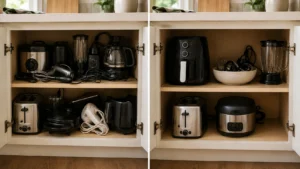
Before adding a shelf, cart, or appliance garage, run a no-buy reset with the storage you already have:
- Empty one appliance zone and wipe it clean.
- Return only the appliances used in the last month, plus genuine seasonal items.
- Move duplicates and uncertain items to a dated holding box outside prime kitchen storage.
- Use an existing tray, bowl, or labeled bag to keep each appliance’s loose parts together.
- Test the arrangement for seven days before deciding whether a measured organizer would solve a remaining access problem.
This test solves visibility and access problems without creating new clutter. Its limit is structural: it cannot make an unsafe shelf stronger, create electrical clearance, or enlarge a cabinet opening.
Maintenance and recheck routine
Recheck the system when something changes rather than organizing by the calendar alone. Useful triggers include a new appliance, a move, a household change, difficulty lifting, an appliance that stops returning to its home, blocked prep space, cord damage, a leak, a shelf problem, or revised manufacturer instructions.
A five-minute reset is enough: return loose parts, inspect the cord and storage surface, remove anything blocking retrieval, and note appliances that were not used. Seasonal items can rotate into easier storage when their season begins and move back afterward.
Printable Appliance Home Worksheet
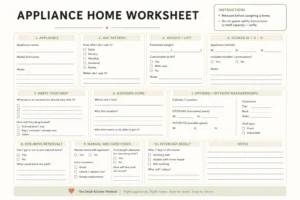
Complete one line per appliance. Add a second page if needed. Do not guess safety instructions or shelf capacity; write ‘verify’ and check the correct source.
| Appliance | Use a pattern. | Weight / lift | Stored W x D x H | Parts together? |
| Assigned home | Opening / interior measurements | One-move retrieval? | Manual and cord check | Seven-day result |
Frequently asked questions
Should small appliances be kept on the counter?
Only the appliances that justify the space. A daily-use appliance may belong on the counter if it leaves a usable prep zone and can operate according to its manual. Weekly or occasional appliances usually work better in easy cabinet storage. The goal is functional calm, not an empty counter at any cost.
Where can I store appliances if I do not have a pantry?
Start with the front of a stable lower cabinet, a dining-room cabinet near the kitchen, or a freestanding cart that does not obstruct traffic. Keep the route short and the storage dry. High shelves are better for light occasional items than heavy appliances. Measure the opening and retrieval path before assigning the home.
Can I store a small appliance under the sink?
It is usually a poor default for electrical appliances because plumbing increases the chance of leaks and moisture, and cleaning chemicals may share the space. A manufacturer’s instruction to store the appliance in a clean, dry place points toward a different cabinet. If under-sink space is your only option, resolve the plumbing and storage risks first rather than assuming it is suitable.
Can I use an appliance while it is inside a cabinet?
Do not assume that a storage location is an operating location. Heat-producing appliances may need model-specific airflow, steam clearance, lid or basket movement, a suitable surface, and direct access to a receptacle. Move the appliance to the operating position described in its manual unless the cabinet system and appliance were specifically designed and installed for in-cabinet use.
How should I store appliance cords?
Unplug by grasping the plug, not pulling the cord. Use the appliance’s built-in cord storage if provided, or arrange a loose loop without sharp bends, tight wrapping, pinching, or strain where the cord enters the appliance. Stop using a damaged cord or plug and follow the manufacturer’s repair guidance. [2]
Is the top of the refrigerator a good appliance shelf?
Usually not for heavy or frequently used items because retrieval is high and awkward. The surface may also be warm, dusty, or unstable for a particular appliance. Use it only when the appliance is light, the location is dry and stable, access is safe, and the refrigerator and appliance instructions do not create a conflict.
What should I do with an appliance I rarely use but am not ready to remove?
Give it a dated holding period outside prime kitchen storage. Record the next realistic occasion when you expect to use it. If that occasion passes and another tool handled the task, you have evidence for donating, selling, recycling, or letting it go—without making the decision in the middle of a stressful declutter.
Bottom line
The best way to store small appliances in a small kitchen is to match access to real use. Daily appliances get the easiest safe location. Weekly appliances get one-move cabinet access. Light, occasional items can move deeper or higher. Heavy items stay within a comfortable lifting zone. Anything that no longer helps your cooking routine should not occupy prime space by default.
Start by auditing what should stay on your small kitchen counter. For heat-producing appliances, verify how much clearance the exact model needs. If the audit shows that an air fryer genuinely earns a place, compare the best slim air fryers for small kitchens or read the Bella 4-Quart Slim Air Fryer review. If one appliance may replace another, continue with the planned air fryer versus toaster oven comparison.
Sources & References
The following authoritative sources were consulted to support the electrical-safety, appliance-storage, ergonomics, and maintenance guidance in this article.
Electrical & Home Appliance Safety
National Fire Protection Association (NFPA) — Electrical Safety
https://www.nfpa.org/education-and-research/home-fire-safety/electrical
Supports general electrical-safety guidance, including safe use of household electrical equipment and reducing electrical fire hazards.
U.S. Consumer Product Safety Commission (CPSC) — Home Electrical Safety
https://www.cpsc.gov/s3fs-public/513.pdf
Supports guidance concerning electrical products, power cords, plugs, and household electrical hazards.
U.S. Fire Administration (USFA) — Home Fire Safety
https://www.usfa.fema.gov/prevention/home-fires/
Provides broader federal guidance on preventing fires and reducing hazards in the home.
Ergonomics & Appliance Storage
Occupational Safety and Health Administration (OSHA) — Ergonomics
https://www.osha.gov/ergonomics
Supports guidance concerning lifting, reaching, awkward postures, and reducing ergonomic strain.
Occupational Safety and Health Administration (OSHA) — Ergonomics Technical Manual
https://www.osha.gov/otm/section-7-ergonomics/chapter-1
Provides additional technical guidance on lifting, reaching, storage height, and ergonomic risk factors.
Appliance Safety Standards
UL Solutions — Household Appliances
https://www.ul.com/industries/products-and-components/appliances/household-appliances
Provides background on safety requirements and standards applicable to household electrical appliances.
UL Solutions — IEC 60335-1: Safety of Household and Similar Electrical Appliances
https://www.ul.com/services/iec-60335-1-standard-safety-household-and-similar-electrical-appliances
Provides information about the international safety standard covering household and similar electrical appliances.
International Electrotechnical Commission (IEC) — Standards
https://www.iec.ch/standards
Provides the international standards framework for electrical and electronic equipment, including household appliances.
Pingback: Best Compact Coffee Makers for Limited Counter Space